
A haul is not cheaper merely because several items travel together. Consolidation can reduce repeated base charges and unused packaging, but parcel size, route restrictions and timing still matter. Good planning begins before the first item reaches the warehouse.
Lolobuy's public website currently advertises 180 days of free storage and describes consolidation followed by international shipping. Treat that as a planning window rather than a reason to wait until the last day; always confirm the live storage terms and order deadlines in your account.
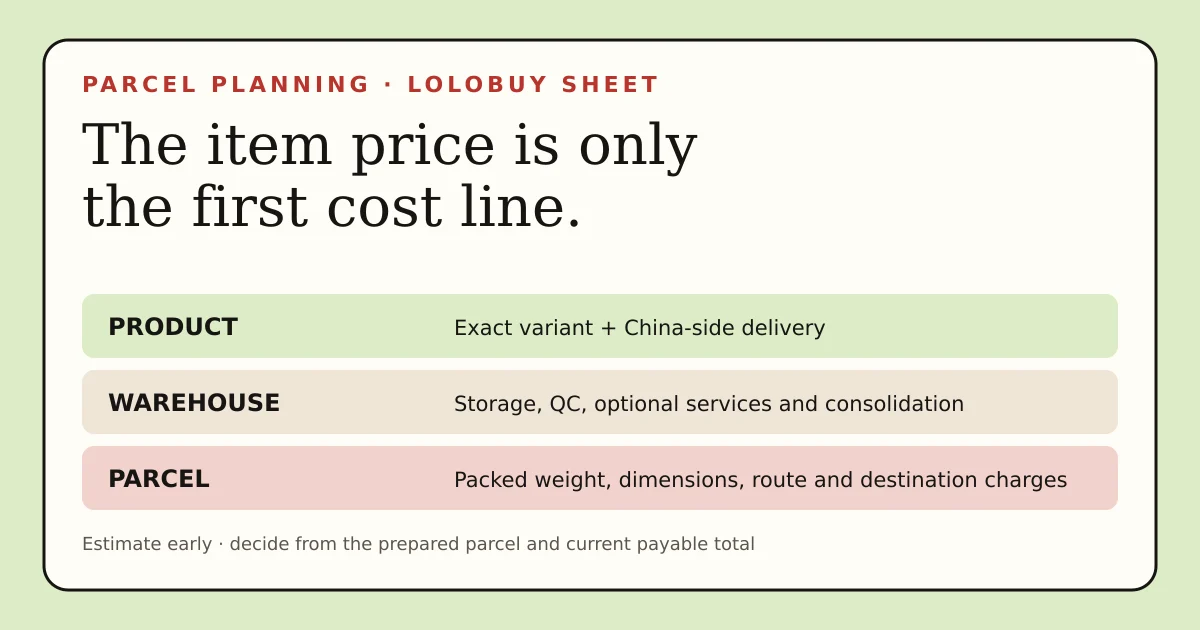
The product price is only the first line.
Keep estimates and confirmed charges separate. The final international choice becomes meaningful only after the warehouse has parcel data.
Product
Selected variant at the current seller price.
China-side cost
Domestic delivery and any clearly disclosed order charges.
Parcel
Packaging, actual weight, dimensions and route rules.
Destination
International freight plus applicable tax or customs obligations.
01
Start with what LoloBuy actually publishes
LoloBuy's public website says that it assists with purchases from Chinese sales channels, inspects and photographs goods after warehouse arrival, and provides 180 days of free storage. A public ordering guide in its named Reddit community describes storing multiple arrivals, consolidating them, selecting an international route and receiving tracking after dispatch. Together, those sources support the basic warehouse-agent flow.
They do not create a permanent price list for your parcel. The public homepage does not give one universal shipping rate, because a usable quote needs a destination, an eligible line and parcel data. Route names, delivery estimates, restricted-item rules, compensation and promotions can change. A responsible shipping guide therefore teaches the questions to ask instead of copying a price that may already be stale.
The same caution applies to the 180-day statement. It is a public planning fact as of the date of this guide, not permission to ignore the order clock. Check how the account displays each item's storage start and any exceptional status, then set your own deadline comfortably earlier.
02
Build the parcel on paper first
List each intended item with an estimated weight, broad dimensions, material and any special handling concern. You do not need perfect data at the browsing stage. The purpose is to notice combinations that may create a poor parcel, such as a bulky puffer jacket mixed with dense footwear or a fragile accessory surrounded by heavy items.
Separate wants from must-haves. If one late item would hold the entire parcel beyond your preferred shipping date, decide in advance whether you would ship without it. That avoids a rushed choice after other items have already arrived.
RELATED DECISION PATHS
Continue with the evidence that answers the next question.
These links sit inside the guide because each one covers a decision that follows directly from this step.
03
Keep estimates in ranges
A pre-purchase weight from a seller page is useful for rough planning, but it is not the packed weight. Size selection, retail boxes, protective material and consolidation all change the result. Record a low and high estimate instead of one precise-looking number. The range reminds you that the cost is unresolved while still helping you spot a parcel that is likely to be dense or bulky.
Do the same with timing. Seller dispatch, Chinese domestic delivery, warehouse intake, QC review, problem resolution, packing, export handling and destination customs are separate stages. Adding their advertised best-case times produces false confidence. Build a buffer around the date you actually need the parcel and avoid ordering time-sensitive goods with no room for delay.
- Estimated item weight: low and high
- Likely retail packaging: removable or protective
- Fit with other items: compatible, fragile or restricted
- Personal ship-by date: earlier than the storage maximum
04
Understand actual and volumetric weight
Actual weight is what the packed parcel weighs on a scale. Volumetric weight converts the parcel's outer dimensions into a chargeable weight using the carrier's formula. A carrier may charge whichever is higher. The divisor and rules vary by route, so a generic online calculator is only an estimate.
Soft items may compress; rigid shoe boxes, helmets and decorative objects may not. Removing unnecessary retail packaging can reduce volume, but it can also reduce protection or affect the condition in which an item arrives. Decide based on the item, not a blanket rule.
- Dense and compact items are usually driven by actual weight.
- Light but bulky items can be driven by volumetric weight.
- Outer packaging and protective materials change both figures.
- The warehouse parcel data is more useful than a pre-purchase guess.
05
Use warehouse storage as a buffer
Storage allows items from different sellers and arrival dates to wait for consolidation. It also gives you time to review QC photos and resolve a problem before international shipping. Record the warehouse arrival date of each item and set an earlier personal deadline than the platform maximum.
Do not assume every item shares the same storage clock or status. Cancelled, returned or exceptional orders may follow different rules. Lolobuy's public 180-day statement is helpful context, but the order record and current terms should guide action.
06
Consolidate with compatibility in mind
A good consolidated parcel combines items that can travel safely and through the same route. Batteries, liquids, magnets, food, branded goods and other restricted categories can face route limitations. Restrictions vary by destination and carrier and can change, so check eligibility before building the entire plan around one shipping line.
Heavy items can crush softer goods if internal packing is poor. Fragile products may benefit from reinforcement, corner protection or a separate parcel. Packaging services can add weight and dimensions, but that trade-off can be worthwhile when damage risk is meaningful.
07
Compare consolidation with splitting honestly
Consolidation can remove duplicated outer boxes and may avoid paying several minimum or first-weight charges. That does not mean one large parcel is always cheaper. A bigger carton can cross a route's size threshold, trigger volumetric weight, mix an ineligible item with otherwise eligible goods or concentrate too much value and risk in one shipment.
Splitting can isolate a restricted or fragile product and keep the rest of the haul on a suitable line. It can also duplicate base charges, packaging and tracking work. Compare the two realistic parcel plans after warehouse weights and dimensions are available: one consolidated quote versus two eligible quotes. Do not compare one confirmed price with a guessed alternative.
There is also a practical middle ground. Remove unnecessary packaging from soft goods where safe, keep protection for structured or fragile items, and group products by compatible route. The goal is not the fewest boxes; it is the best balance of eligibility, protection, cost and the consequences if one parcel is delayed.
08
Compare routes on more than headline price
The cheapest route is not automatically the best fit. Compare chargeable weight rules, estimated delivery window, tracking quality, compensation limits, restricted-item policy and destination-country handling. Estimated delivery is not a guarantee, especially around holidays, weather disruptions and customs processing.
Taxes and import rules belong to the destination country. A shopping directory cannot determine your legal obligations. Review the carrier description and official customs guidance for your destination, and declare contents accurately.
09
Read tracking as a sequence of scans
Tracking usually records events, not continuous movement. A parcel can travel between facilities while the public page shows no new scan. The first tracking number may belong to a logistics partner before a local carrier receives the shipment, and translated status text can be vague. Keep the parcel number, route name and dispatch date together so you know which party currently has the useful information.
A quiet tracking period is not by itself proof that the parcel is lost. Compare it with the route's current guidance and contact the appropriate support channel when it exceeds that guidance or shows an exception. Customs review and local delivery sit outside the warehouse's direct control, so avoid promising readers a fixed arrival date.
10
Rehearse the final submission
Before paying for international shipping, review the parcel contents, delivery address, selected route, declared information, insurance or protection options, packaging requests and final chargeable weight. Keep the parcel number and tracking information together.
If the final quote is much higher than the planning estimate, look for the cause rather than immediately switching routes. Parcel dimensions, added packaging, a restricted category or a different weight rule may explain the gap. A smaller parcel split can sometimes help, but it can also repeat base charges.
11
A useful planning rhythm
Browse with total cost in mind, inspect each arrival, resolve issues early, consolidate compatible items, compare eligible routes and review the final parcel before payment. That rhythm uses the warehouse as a decision point rather than treating it as an automatic conveyor belt.
SOURCES
Research basis
Platform claims and customer observations are kept separate. The notes below identify the research basis without sending visitors away from this guide. Confirm current account terms before acting.
- LoloBuy public websitePublic 180-day free-storage and warehouse-service statements.
- LoloBuy community ordering guideDescribes consolidation, route selection, international payment and tracking stages.