A useful Lolobuy spreadsheet is not simply a long wall of product links. Its real job is to reduce the time between having a vague idea and reaching a listing that you can evaluate properly. Categories, clear search terms and readable product pages help with discovery; they do not remove the need to verify the seller page, current price, options and shipping restrictions.
This guide explains a cautious workflow for moving from an editorial find to a purchase decision. It deliberately separates what a directory can tell you from what must be confirmed on the destination page or later in warehouse quality-control photos.
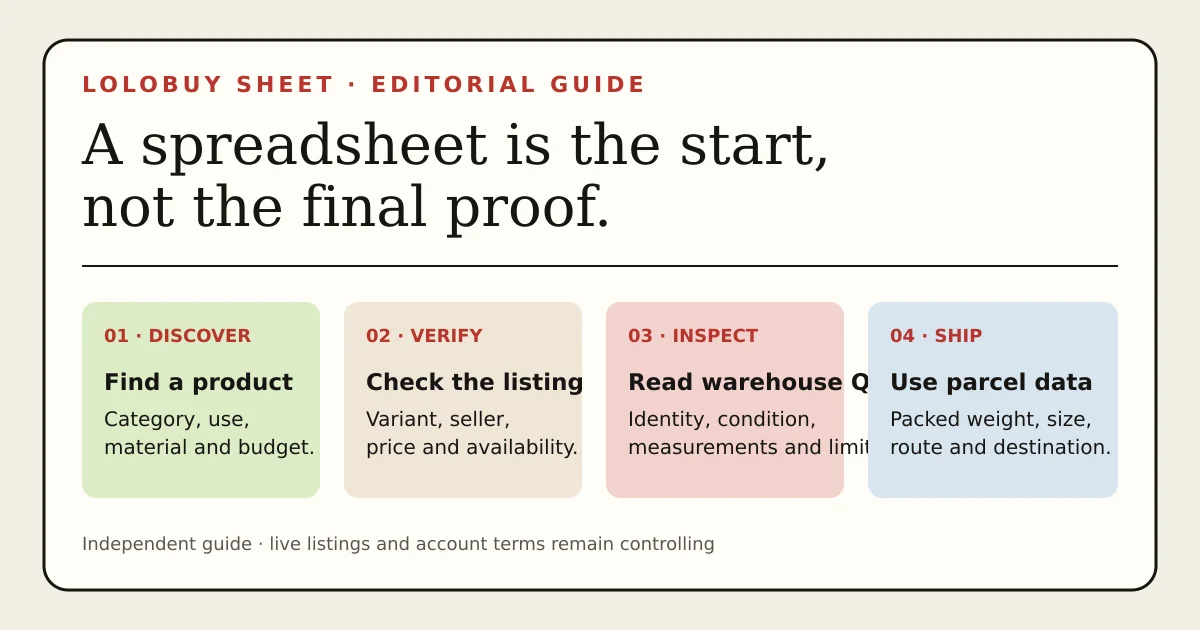
One decision, four different sources.
The directory starts the search. The live listing, warehouse evidence and final parcel quote each take over at a different stage.
Directory
Find a product idea and compare categories.
Live listing
Confirm the seller, option, current price and description.
Warehouse QC
Inspect the physical item that arrived for your order.
Packed parcel
Choose shipping from current weight, dimensions and eligibility.
01
Start with intent, not with an endless feed
Before opening dozens of products, write down the category, preferred material, approximate measurements, acceptable color range and maximum item price. That small brief gives every later comparison a purpose. A shopper looking for a lightweight jacket for spring has a different decision to make from someone seeking a padded winter layer, even when both products sit under the same category.
Use broad category pages to learn the available vocabulary, then narrow your search. Search terms that describe the item itself usually work better than a long string of brand references: try the garment type, material, color or construction detail. If the search result is too broad, remove decorative words and keep the attributes that matter.
- Define the item type and its intended use.
- Record must-have measurements or fit preferences.
- Set separate limits for the item price and the total landed cost.
- Keep two or three candidates instead of committing to the first result.
02
Treat every directory entry as a lead
Product directories can organize links, but listings are controlled by their destination websites. Sellers can change photos, stock, variants, prices, descriptions and shipping availability without the directory changing at exactly the same moment. For that reason, the live destination page is the authority for the current offer.
Open the listing and check that its title, gallery, variant selector and description still refer to the product you expected. A low headline price may belong to a small accessory or a deposit rather than the item shown in the first image. Select the intended color and size before judging the displayed price.
If the seller provides a size chart, compare the garment measurements with an item you already own. Labels such as M or XL are not universal. Shoulder width, chest width, total length, sleeve length, waist and inseam are more useful than the printed size name.
RELATED DECISION PATHS
Continue with the evidence that answers the next question.
These links sit inside the guide because each one covers a decision that follows directly from this step.
03
Know which parts of the LoloBuy flow are publicly confirmed
LoloBuy's public homepage says that it assists with purchases from Chinese online and offline channels and that a shopper can begin by pasting a product link. It also says that, after the merchant sends the item to the warehouse, the warehouse conducts a quality inspection, takes photographs and provides 180 days of free storage. Those are useful, specific claims because they describe the hand-off points a shopper should expect.
A public ordering guide in LoloBuy's named Reddit community expands that flow into account creation, product selection, order submission, payment, procurement, warehouse arrival, QC photos, consolidation, route selection and tracking. We use that guide as supporting context, not as a substitute for the live account. Payment methods, available carriers, coupons and route names can change more quickly than an educational article.
This distinction matters for search quality. A helpful Lolobuy spreadsheet should explain the process the platform actually describes while refusing to invent a permanent fee table, a guaranteed delivery time or a fixed number of free QC images. When a public source is silent, the honest answer is to check the current order screen or ask support before paying.
04
Turn a source link into an order note
A raw marketplace URL is not enough when a listing has many options. Alongside the link, record the exact color name, size, quantity and any seller instruction that affects the order. Save the relevant size chart and note whether the displayed price changed after selecting the option. This takes less than a minute and gives the warehouse stage a clean reference.
If a listing uses translated text, keep the original option wording as well as your translation. Two colors can receive nearly identical machine-translated names, and a seller may identify a variation by an image rather than a sentence. A precise note reduces ambiguity without pretending that the directory controls how the seller fulfils the order.
- Source URL and date checked
- Exact option wording and reference image
- Size chart or key measurements
- Visible product price and domestic-delivery line
- One sentence describing the non-negotiable detail
05
Be skeptical of spreadsheet claims that outrun the evidence
Words such as verified, best, cheapest and daily updated sound useful but need proof. A product being present in a directory does not prove that the seller is reliable, the item is authentic, the link was checked today or the final parcel will be inexpensive. A responsible directory dates meaningful reviews, links to the live destination and explains what it did and did not verify.
The same rule applies to customer reviews. A detailed post with order context and visible QC examples is more useful than an anonymous five-star sentence, but one successful order still does not establish a platform-wide rate. Read reviews for the specific evidence they contain—handling of a mismatch, image clarity, response timing or parcel outcome—and avoid turning a single report into a universal promise.
06
Separate listing photos from warehouse QC photos
Seller photos are marketing material. Warehouse quality-control photos document the physical item that arrived for your order. The two image sets answer different questions. The seller page helps you understand the promised design and options; QC photos help you compare the received item with that promise.
Lolobuy's public shopping flow describes inspection and photographs after an item reaches the warehouse. Exact photo coverage and any optional services can change, so confirm the current service details inside the platform before relying on a particular angle or number of images.
When QC images become available, first verify the basic identity of the item: color, selected variant, quantity and visible size tag. Then move to construction, symmetry and obvious damage. A request for an additional image should be specific—such as a close-up of a seam or a measurement beside a ruler—rather than a general request for a better photo.
07
Calculate a decision price, not only an item price
The amount on the product page is only one part of the final cost. Domestic delivery to the warehouse, service charges where applicable, international shipping, packaging choices and destination-country taxes can all affect the total. Bulky but inexpensive items can be costly to ship because some routes use volumetric weight.
A simple planning estimate is enough at the discovery stage: item price plus domestic delivery plus a conservative share of international shipping. Do not present that estimate as a quote. Final shipping options depend on the packed parcel, route, destination and current carrier rules.
- Check whether domestic shipping is included or added later.
- Note estimated item weight and whether the item is unusually bulky.
- Leave room for packaging and consolidation changes.
- Review the final parcel quote before submitting international shipping.
08
Keep a short verification record
When comparing several products, save the destination URL, selected option, seller size chart, current price and the date you checked it. A screenshot can help when a listing changes, but the live page still controls the order. This record also makes it easier to explain a mismatch during the warehouse stage.
Bookmarks on this site are a lightweight browsing aid for the current page session. They are not a guarantee that a listing will stay available. Return to the destination page before ordering and repeat the essential checks.
09
The practical rule
Use a Lolobuy spreadsheet to discover and organize. Use the live listing to confirm what is being sold. Use warehouse QC photos to inspect what physically arrived. Use the final parcel quote to choose shipping. Keeping those four stages separate prevents a directory from being mistaken for a seller, an inspector or a freight quotation.
SOURCES
Research basis
Platform claims and customer observations are kept separate. The notes below identify the research basis without sending visitors away from this guide. Confirm current account terms before acting.
- LoloBuy public websitePublic purchasing, warehouse inspection, photography and 180-day storage statements.
- LoloBuy community ordering guidePublic nine-stage ordering overview posted in the platform's named Reddit community.