Warehouse QC photos are most useful when you approach them with a checklist. Looking only for an overall impression makes small but important problems easy to miss; zooming into every pixel can create false alarms caused by lighting, compression or the camera angle.
The goal is not to prove that an item is perfect. It is to confirm that the received item matches the order closely enough for you to make an informed accept, exchange or return decision within the platform's available process.
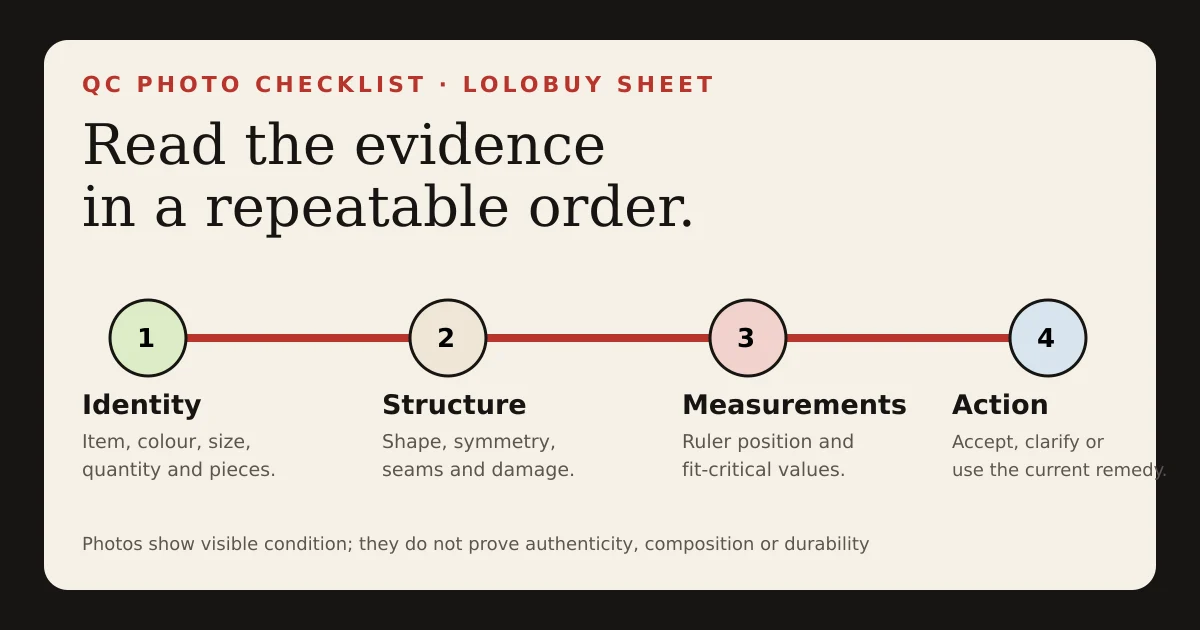
Review the evidence in the right order.
A calm sequence prevents a tiny cosmetic detail from distracting you from the wrong size, missing piece or structural problem.
Identity
Item, color, size, quantity and included pieces.
Structure
Shape, symmetry, alignment and visible damage.
Measurements
Fit-critical dimensions compared with a known item.
Action
Accept, request one focused check, or use the current remedy.
01
Begin with order identity
Before examining stitching or texture, confirm that the photographs belong to the correct item. Compare the ordered color, model, size and quantity with what is visible. Look for the size tag or packaging label where it is shown, but remember that a tag alone does not prove fit.
Check whether the set is complete. Shoes should normally appear as a pair; a multi-piece outfit should include the expected pieces; accessories advertised with a strap, pouch or detachable part should be compared with the listing contents. Packaging may differ from marketing photos and should not be assumed unless it was explicitly part of the offer.
- Correct item type and color
- Correct size or selected variant
- Correct quantity and expected pieces
- No obvious transit or handling damage
02
Keep the public fact boundary clear
LoloBuy's public homepage confirms that items are inspected and photographed after the merchant sends them to the warehouse. It does not, on the public page we checked, specify a universal number of free photographs, a permanent price for extra angles or a guaranteed video-inspection service. Those details should therefore be verified in the current account interface or with support, not copied from an old promotion or another agent's policy.
That boundary is practical, not merely cautious wording. QC coverage can differ by product type, service tier or current warehouse procedure. Build your first decision from the images that are actually attached to the order. If a critical question remains, check what focused inspection options are available before the return or exchange window closes.
RELATED DECISION PATHS
Continue with the evidence that answers the next question.
These links sit inside the guide because each one covers a decision that follows directly from this step.
03
Read shape and symmetry before small details
Large structural problems matter more than tiny cosmetic variation. For clothing, compare sleeve length, shoulder alignment, collar shape and the way the garment lies flat. For shoes, compare the left and right toe shape, heel height, panel placement and sole alignment. For a bag, inspect the overall silhouette, handle placement and whether the body sits evenly.
Camera perspective can exaggerate asymmetry. Use several angles when they are available and compare features that sit at the same distance from the camera. If only one angle makes a part look distorted, ask whether perspective or folding could explain it before treating it as a defect.
04
Allow for lighting, compression and camera distance
Warehouse photographs are evidence, but they are still photographs. Overhead lighting can make black fabric look washed out, a warm bulb can shift white toward cream, and a wide-angle phone lens can make the nearest edge appear larger. Image compression can also turn fine texture into blocky noise. Compare the same feature across several frames before deciding that the physical item is discolored or misshapen.
Use fixed references when they are visible. A neutral background, ruler, size tag, outsole edge or repeated panel can help you judge scale and alignment. If exact color is central to the purchase, ask for a clearly described lighting condition when the platform offers that option, while accepting that no screen reproduces color perfectly.
05
Use measurements to answer fit questions
A photograph cannot tell you how a garment will fit without a reference. Measurement images are therefore among the most valuable QC records. Compare the ruler placement with the seller's chart and with a garment you know fits. Make sure the item is laid flat and that the measurement starts at the correct seam or edge.
Allow for small differences caused by manual measurement, fabric stretch and how the garment is positioned. A meaningful discrepancy is one that changes the intended fit, not a few millimeters created by a tilted ruler. If a critical measurement is missing, request that exact measurement rather than a generic extra photo.
06
Ask for one answer, not simply more photos
A vague request such as “take a better picture” leaves the photographer to guess what matters. A useful request names the feature, angle and reference: measure the insole from heel to toe; photograph the left shoe's inner panel beside the right shoe; show the jacket chest width with the garment flat; or capture the zipper teeth at the point where they appear misaligned.
Prioritize requests that can change the decision. An extra logo close-up may be interesting, but a missing size measurement, cracked component or incorrect color is more likely to determine whether you accept the order. Group related questions when the service permits it, and avoid asking for a photograph that still cannot establish comfort, material composition or long-term durability.
- Name the exact feature or measurement.
- State the angle or comparison you need.
- Explain the suspected mismatch in one sentence.
- Choose evidence that could change the accept-or-action decision.
07
Clothing checklist
For tops and jackets, inspect the neckline, zipper path, button spacing, print or embroidery placement, pocket symmetry and major seam lines. Check for stains, pulls, holes and visibly loose stitching. Dark garments may hide details in underexposed images, while pale fabrics can look warmer or cooler under warehouse lighting.
For trousers and shorts, compare the rise, leg shape, waistband, pocket placement and hem. If the style depends on a wash or pattern, compare the overall treatment rather than expecting every mark to be identical to a sample photograph.
08
Shoes, bags and accessory checklist
For shoes, compare both sides of the pair, outsole attachment, visible glue, stitching paths, lace hardware, heel counters and the alignment of repeated panels. Minor adhesive traces can look dramatic in a close crop; decide whether they are removable cosmetic residue or a sign of separation.
For bags, inspect the front and back shape, corners, handles, strap attachments, zipper path, lining and hardware color. Request a close-up when a clasp, engraving or seam is important. For jewelry and small accessories, scale is easy to misread, so use item dimensions and a ruler image when available.
09
Know what photos cannot establish
QC photos cannot reliably prove long-term durability, exact material composition, comfort, electronics performance or authenticity. They also cannot show every hidden seam or internal component. Treat claims that every photographed item is fully verified with caution unless the service clearly defines what was inspected.
Color accuracy is limited by lighting and screens. If a precise shade matters, compare multiple images and the seller's option name, but expect some uncertainty. Odor, softness and sound are also outside the normal scope of a photograph.
10
Save the evidence before the parcel moves on
Keep the order reference, listing screenshot, selected option and important QC frames together until the transaction is complete. If you raise an issue, record the date, the image number and the outcome you requested. A short evidence trail is easier for support to follow than a long message built from memory.
Do not let documentation become a reason to miss a deadline. Warehouse remedies depend on the seller and the platform's current process, and some listings may limit returns. Check the available action and time window first, then provide the clearest evidence you have. A good QC review ends with a timely decision, not an endlessly growing gallery.
11
Make a calm accept-or-action decision
Classify findings into three groups: normal variation, a cosmetic issue you can accept, and a mismatch or defect that materially affects the order. Then check the platform's current deadline and available action. If you contact support, identify the photo, location and requested outcome clearly.
Lolobuy publicly describes warehouse inspection and photography in its shopping flow, but service details and remedies may change. The current order page and support process are the authority for deadlines, extra-photo requests, exchanges and returns.
SOURCES
Research basis
Platform claims and customer observations are kept separate. The notes below identify the research basis without sending visitors away from this guide. Confirm current account terms before acting.
- LoloBuy public websiteConfirms quality inspection and photography after warehouse arrival.
- Early independent LoloBuy user reportOne shopper's preliminary report on QC photos, a size mismatch and support response; not a representative score.